Yes, foreigners can buy property in Dubai, and they can own it outright. Since Dubai opened freehold ownership to non-UAE nationals in 2006, buyers from almost every country have purchased apartments, villas and townhouses in the city’s designated freehold areas. You do not need to live in the UAE, hold a residence visa or set up a company to buy.
The process is well regulated, but it differs depending on whether you buy off-plan from a developer or a ready property from a seller. This guide walks you through each step, the documents you need, how payments are protected and how financing works for international buyers in 2026.
Can foreigners buy property in Dubai?
Yes. Under Dubai Law No. 7 of 2006 on real property registration, non-UAE nationals can own freehold property in areas designated by the Ruler of Dubai. The first list was set out in Regulation No. 3 of 2006 and has been expanded since. Freehold areas include most of the communities international investors know: Downtown Dubai, Business Bay, Dubai Marina, Palm Jumeirah, JVC, Dubai Hills Estate, Dubai South and Dubai Islands, among many others.
Freehold means you own the unit and a share of the common areas, with a title deed in your name. You can sell, lease or pass on the property like any other owner.
Off-plan or ready: choose your route first
| Off-plan (from developer) | Ready (resale) | |
|---|---|---|
| Cash at the start | Usually 10–20% plus the 4% DLD fee | Full price or mortgage down payment, plus fees |
| Payment | Instalments during construction, often some after handover | Paid in full on transfer day |
| Registration | Oqood (interim register), then title deed at completion | Title deed on transfer day |
| Rental income | From handover | Immediately |
| Main protection | Escrow account and DLD project registration | Title check, NOC and trustee office transfer |
Off-plan made up 68% of Dubai’s sales in Q3 2026, according to our latest market update, mainly because payment plans lower the entry cost for international investors.
How to buy off-plan property in Dubai, step by step
Step 1: Define your budget and goal
Decide whether you are buying for rental income, capital growth, residency or your own use. The answer shapes the area, unit type and payment plan you should look for. Budget about 4% to 5% on top of the price for one-off costs (see every fee explained).
Step 2: Work with a RERA-registered broker
Choose a broker licensed by the Real Estate Regulatory Agency (RERA). When you buy off-plan directly from a developer, the developer normally pays the broker’s commission. A good broker compares developers’ track records, handover history and real payment plan terms, not just brochure prices.
Step 3: Check the developer and the project
Confirm the project is registered with the Dubai Land Department (DLD) and has its own escrow account. You can check project details on DLD’s official channels. Ask for the expected completion date and the developer’s record of on-time handovers.
Step 4: Reserve the unit
You pay a booking amount and sign a reservation form. Many developers accept this remotely, with a copy of your passport.
Step 5: Sign the Sales and Purchase Agreement (SPA)
The SPA sets out the price, payment schedule, specifications, completion date and what happens if either side defaults. Read it carefully or have a lawyer review it.
Step 6: Register in Oqood and pay the DLD fee
The developer registers your purchase in Oqood, DLD’s register for off-plan sales. You pay the 4% DLD fee at this point. Oqood registration is your legal proof of purchase until the building is complete.
Step 7: Pay instalments into escrow
Under Dubai’s escrow law (Law No. 8 of 2007), buyer payments for registered off-plan projects go into a dedicated escrow account and are released to the developer as construction progresses. Always pay into the project’s escrow account, never into a personal or unrelated account.
Step 8: Handover and title deed
At completion, you inspect the unit (an independent snagging check is worth it), pay the final instalment and any handover charges, and your Oqood registration converts into a title deed.
Buying a ready property: how it differs
- Agree the price and sign the Memorandum of Understanding, known as Form F, usually with a 10% security deposit cheque held by the broker.
- The seller obtains a No Objection Certificate (NOC) from the developer confirming there are no outstanding service charges.
- Transfer at a DLD Registration Trustee office. You pay the balance by manager’s cheque, along with the 4% DLD fee and the trustee fee of AED 4,000 plus VAT (AED 2,000 plus VAT under AED 500,000). The new title deed is issued in your name the same day.
Expect total fees of around 6% to 7% for a resale, mainly because a 2% agency commission usually applies.
Documents you need
- A valid passport (an Emirates ID if you are a UAE resident)
- Proof of address and source of funds, which brokers and developers request for anti-money-laundering checks
- The signed reservation form and SPA (off-plan) or Form F (ready)
- A mortgage pre-approval, if you are financing
- A power of attorney, if someone will sign or attend the transfer on your behalf
Can non-residents get a mortgage in Dubai?
Yes, though on stricter terms than residents. The UAE Central Bank caps loan-to-value ratios for residents, while non-resident lending is set by each bank’s policy.
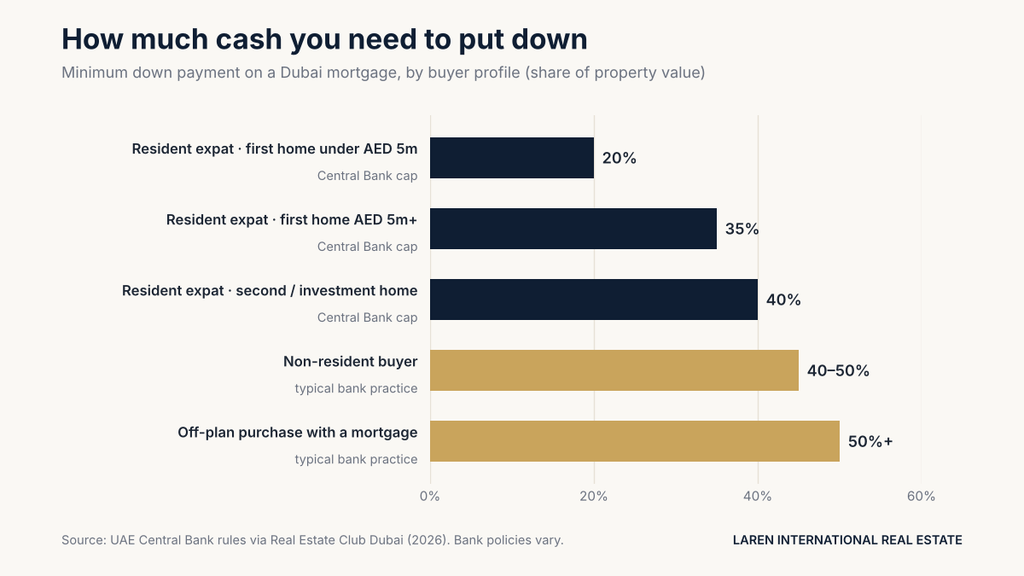
Source: UAE Central Bank mortgage regulation, as summarised by Real Estate Club Dubai (2026). Bank policies vary.
Our view: for most international buyers, off-plan payment plans do the work a mortgage would do elsewhere. Spreading payments over construction lowers the capital you need upfront without taking on interest.
Residency through property
Buying property worth at least AED 2 million can qualify you for a long-term UAE Golden Visa. Rules on off-plan, mortgaged and jointly owned property have specific conditions, which we explain in our guide to the UAE Golden Visa through property.
Five mistakes foreign buyers should avoid
- Paying outside escrow. Off-plan money belongs in the project’s escrow account only.
- Comparing prices, not payment plans. A longer plan or post-handover terms can be worth more than a discount.
- Ignoring service charges. They vary widely and reduce your net yield every year.
- Buying where you would not rent. Rental demand, not views from a show apartment, drives returns.
- Skipping the developer’s track record. On-time delivery history matters more than launch marketing.
Frequently asked questions
Can a foreigner buy property in Dubai without a residence visa?
Yes. Non-residents can buy freehold property in Dubai’s designated areas with a valid passport. A UAE visa is not required to buy or register property.
Can I buy property in Dubai remotely?
Yes. Off-plan purchases can usually be completed remotely. For ready property transfers, you can appoint someone with a power of attorney to sign on your behalf.
How much deposit do I need to buy property in Dubai?
Off-plan developers typically ask for 10% to 20% at booking plus the 4% DLD fee. For a ready property, a 10% security deposit is usual when signing Form F.
Do foreigners pay property tax in Dubai?
No. Dubai has no annual property tax, and individual owners pay no tax on rental income or capital gains from property. Service charges and a municipality housing fee apply.
Can foreigners get a mortgage in Dubai?
Yes. Resident expats can borrow up to 80% on a first home under AED 5 million. Non-residents usually need a down payment of 40% to 50%, depending on the bank.
Ready to buy your first property in Dubai?
Laren International Real Estate guides international investors through every step, from choosing the right project to handover. Explore our Dubai projects, compare opportunities in Abu Dhabi and Ras Al Khaimah, read our FAQ, or book a call with our team.
Sources: Al Tamimi & Company, Who can own real estate in Dubai; Dubai Legislation Portal, Regulation No. 3 of 2006; Property Finder, DLD fees guide (updated July 2026); Real Estate Club Dubai, UAE mortgage LTV rules 2026; UAE Government portal, Golden Visa; Dubai Land Department.
Disclaimer: This article is for information only and is not legal, tax or investment advice. Rules and fees change; confirm current requirements with the Dubai Land Department, your bank and a qualified adviser before you buy.